Do I Have to Rewire My House Because It Has Old Wiring Colours?
A calm, practical guide to old UK wiring colours, red and black cables, brown and blue cables, mixed wiring colours, and when old colours do or do not mean a rewire is needed.
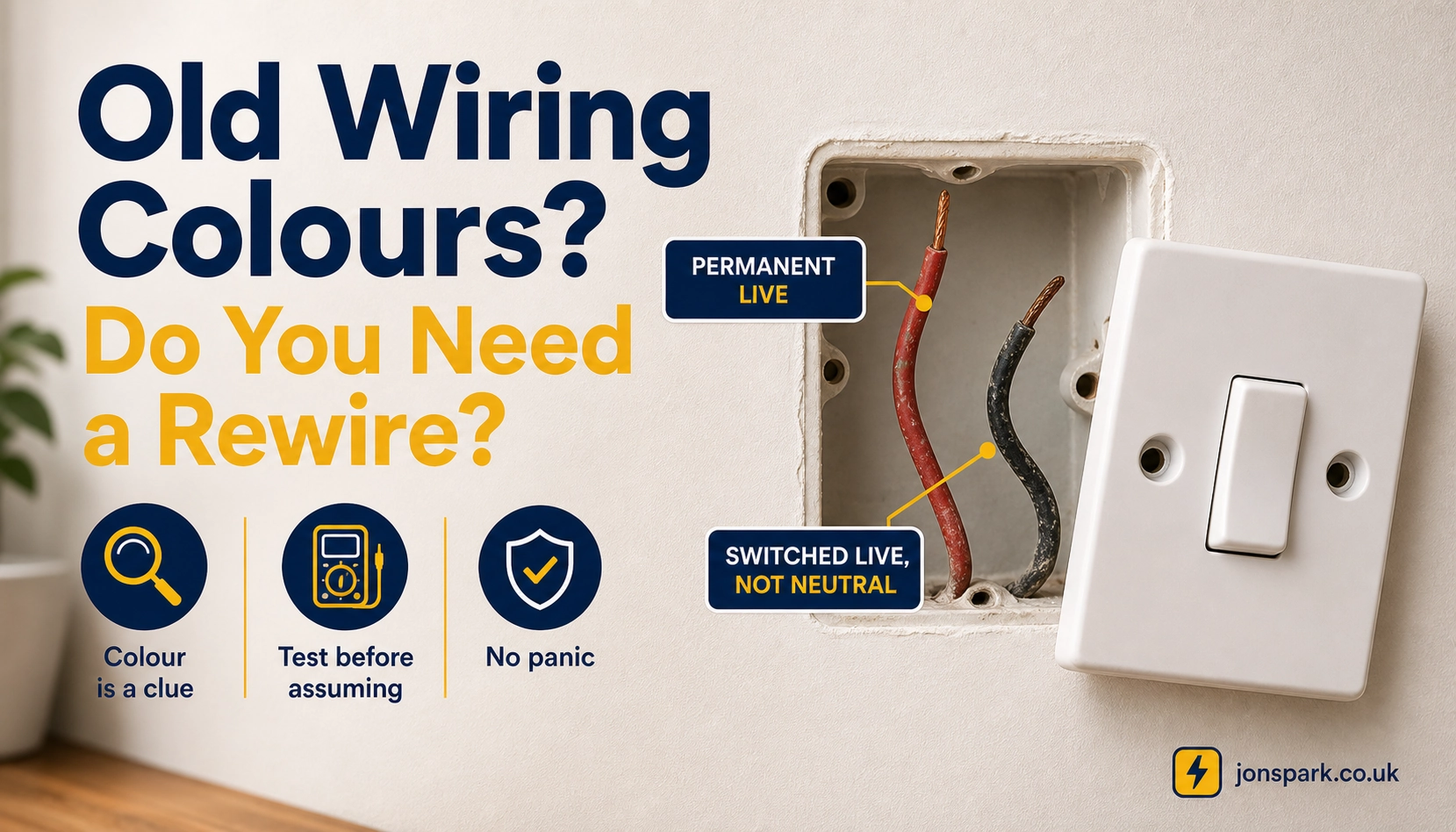
No, old wiring colours do not automatically mean a property needs rewiring. Red and black fixed wiring is still found in many UK homes, flats, rentals, shops, and older buildings.
A rewire is considered because of condition, safety, capacity, damage, poor alterations, lack of essential protection, or major renovation plans. It is not normally recommended simply because the cable colours are old.
About this guide
Jon Spark carries out minor domestic electrical work in Keynsham and nearby areas, helping people with practical small jobs such as sockets, switches, bathroom pull-cords, light fittings, extractor fans, smoke and heat alarms, and simple fault checks.
This guide is written from that small-job perspective: the questions people ask before booking, what can usually be checked from photos, what tends to be discovered on site, and where a simple-looking job needs a qualified judgement rather than guesswork.
Old colours often appear behind light switches, ceiling roses, sockets, and junction boxes. Sometimes the installation is perfectly serviceable for the job being discussed; sometimes the old colours are a clue to look more carefully. The colour is a starting point, not a verdict.
Why did UK wiring colours change?
The UK moved to harmonised wiring colours so fixed wiring colours were more closely aligned with systems used across Europe and international standards. The change was introduced in the 2000s, with a transition period before the new colours became the normal requirement for new fixed wiring work.
This matters because properties now commonly contain a mixture of ages: original circuits, extensions, replacement light fittings, new kitchen wiring, updated consumer units, alarm circuits, outside lights, and small alterations added at different times. A single house can quite legitimately contain both old and new colour schemes.
What were the old UK wiring colours?
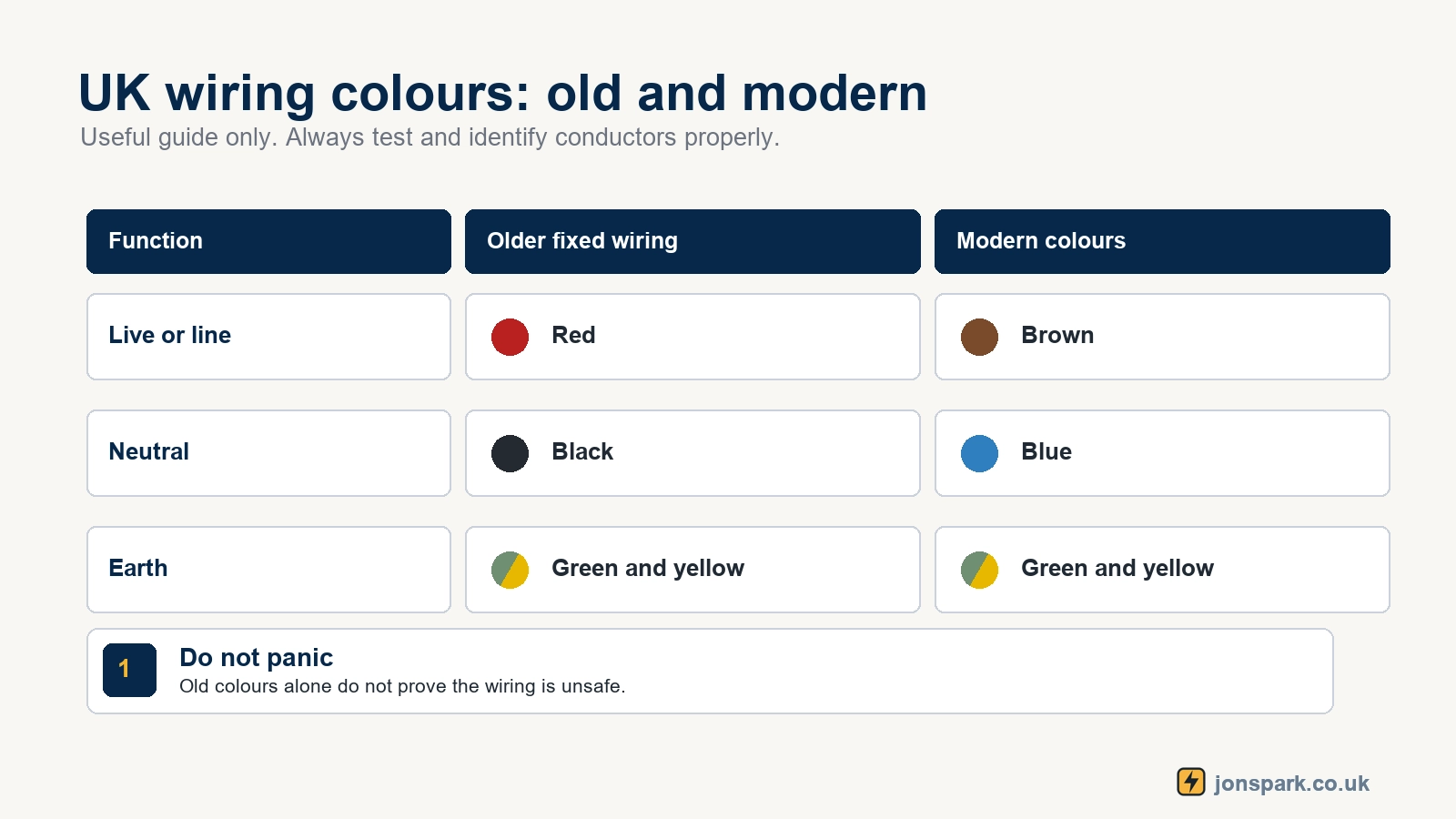
For ordinary single-phase fixed wiring in older UK installations, the common colour scheme was red for live and black for neutral. The protective conductor, often called earth, is identified green and yellow. In many twin-and-earth cables the conductor may be bare inside the cable sheath, but at terminations it should be identified with green/yellow sleeving.
| Function | Old UK fixed wiring colour | Modern harmonised colour |
|---|---|---|
| Live or line | Red | Brown |
| Neutral | Black | Blue |
| Protective conductor / earth | Green and yellow identification | Green and yellow identification |
This table is a useful guide, but it must not be used as a DIY identification method. In real installations, especially at switches, black or blue conductors may not be neutral. They may be used as switched live conductors and should be sleeved or marked appropriately. The safe answer is always to test and identify, not to rely on colour alone.
What are the current UK wiring colours?
For modern single-phase fixed wiring, brown is used for live or line, blue is used for neutral, and green/yellow is used for the protective conductor. These are the colours people now expect to see in new domestic fixed wiring work.
For flexible appliance leads, many people had already been familiar with brown live, blue neutral, and green/yellow earth for a long time before the fixed-wiring change. That is one reason the change can feel confusing: a property might have older red-and-black fixed wiring in the walls, but modern brown-and-blue flex on appliances and fittings.
When did the colours change?
The change to harmonised colours was introduced in 2004, with a transition period before the new colours became required for new fixed wiring work from 2006. That means cable colours can give a rough clue about age, but not an exact installation date. Materials can be stored, work can be phased, and properties are often altered over many years.
Red and black usually suggest older fixed wiring. Brown and blue usually suggest newer or altered wiring. Mixed colours often mean the property has had electrical work at different times. None of those facts alone proves the installation is unsafe.
What about three-phase wiring colours?
Most domestic houses are single-phase, but some larger homes, commercial premises, workshops, farms, blocks of flats, and larger buildings may have three-phase supplies or three-phase distribution. The colour change also affected three-phase wiring.
| Function | Older three-phase colours | Modern harmonised colours |
|---|---|---|
| Line 1 | Red | Brown |
| Line 2 | Yellow | Black |
| Line 3 | Blue | Grey |
| Neutral | Black | Blue |
| Protective conductor / earth | Green and yellow | Green and yellow |
This is one reason colour assumptions can be dangerous. In older three-phase systems, blue may have been a phase conductor. In modern single-phase systems, blue is neutral. Context, testing, labelling, and competence matter.
Does mixed old and new wiring mean something is wrong?
Not automatically. Mixed colours are common where an older installation has had later additions or alterations. For example, an older lighting circuit may have red and black wiring, while a later replacement cable to an outside light, kitchen, extension, or loft area may use brown and blue. That mixture can be perfectly normal if the work was done correctly and labelled where required.
Where an installation contains both old and new colour schemes, there should normally be a warning notice or label at the appropriate point, commonly near the consumer unit or distribution board, telling people that two versions of wiring colours are present. The purpose is simple: anyone inspecting or working on the installation should not assume one colour system applies everywhere.
A property may have an older red-and-black lighting circuit, a newer brown-and-blue bathroom fan cable, and a modern consumer unit. The useful question is not "are there mixed colours?" but "has the work been done safely, labelled properly, and tested where needed?"
The biggest trap: switch wires are not always neutral
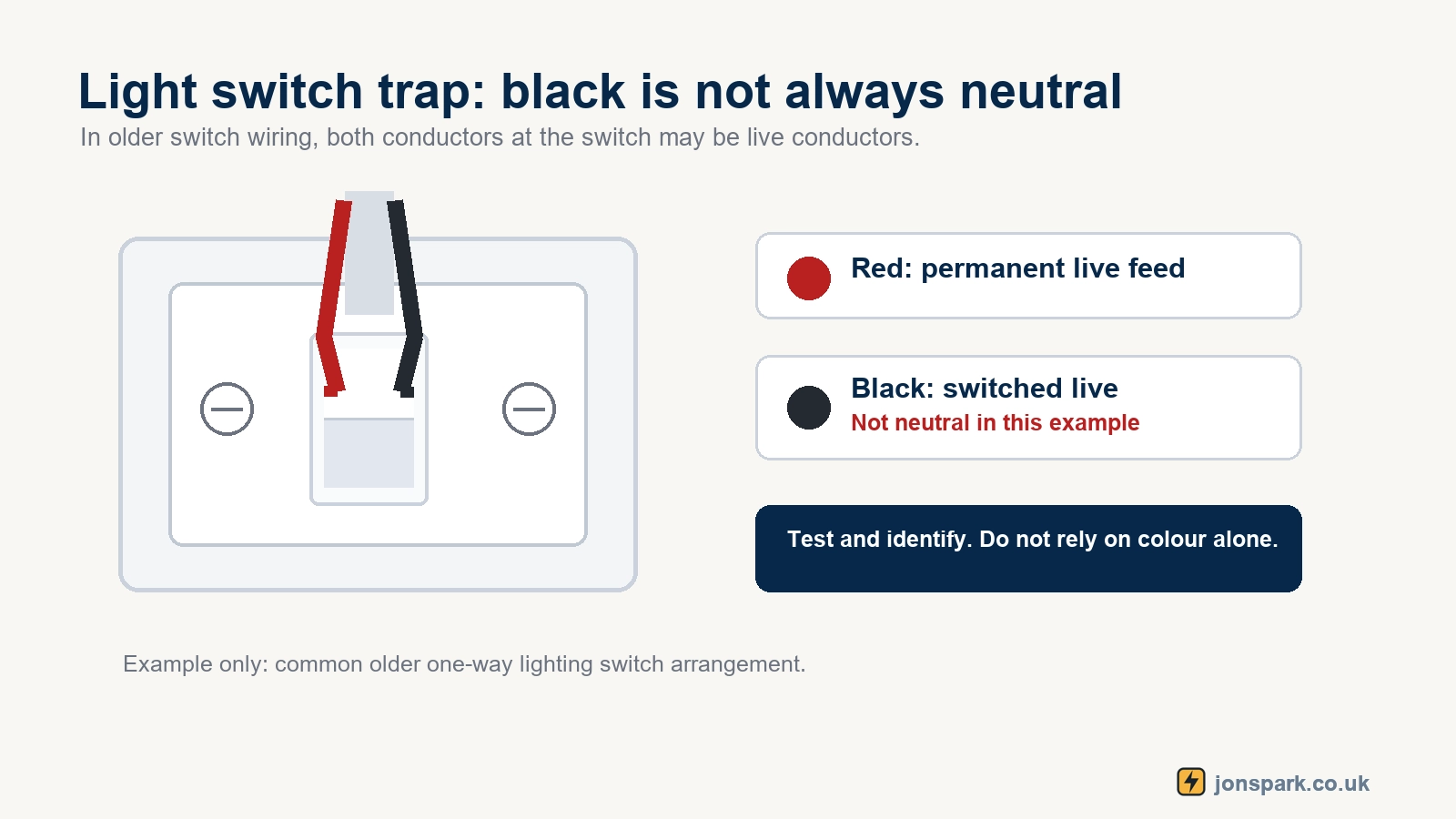
Light switches are where wiring colours cause many misunderstandings. In a traditional UK lighting circuit, the neutral may be at the ceiling rose or light fitting, not at the wall switch. The switch may only have live conductors: one permanent live and one switched live returning to the light.
In older wiring, a black conductor at a switch might be used as a switched live, not a neutral. In newer wiring, a blue conductor at a switch might also be used as a switched live, not a neutral. It should be sleeved or marked to show that use, but older work and poor alterations are not always labelled well.
This matters for modern upgrades such as smart switches, dimmers, bathroom fan controls, and decorative metal faceplates. A person may open a switch and think they have neutral because they can see black or blue. That assumption can be wrong.
Do old colours mean the wiring is unsafe?
No. Cable colour is not the same as cable condition. Old colours can be found in installations that are still serviceable, and newer colours can be found in poor alterations. The real questions are about design, condition, protection, workmanship, testing, and whether the installation is suitable for how the property is used now.
Signs that are more important than cable colour
- Frequent tripping, blown fuses, or unexplained power loss.
- Sockets, switches, plugs, or accessories that feel warm, smell hot, buzz, or show scorch marks.
- Cracked, loose, damaged, or badly fitted accessories.
- Rubber, fabric, lead-sheathed, or visibly perished old cable.
- DIY-looking joints, taped connections, hidden junctions, or cables not properly enclosed.
- No RCD protection where it would now be expected, especially for sockets or outdoor equipment.
- Lighting circuits with no circuit protective conductor where metal fittings or switches are wanted.
- Too few sockets, excessive extension lead use, or signs that the property has outgrown the original installation.
When might a rewire actually be discussed?
A rewire is a major job and should not be suggested lightly. It might be discussed where an installation is in poor condition, has unsafe or deteriorated cable, has extensive poor alterations, lacks essential protective measures, is not suitable for the property's current use, or is being renovated so extensively that rewiring becomes practical while walls and floors are already open.
It may also be raised after inspection and testing if there are widespread faults, damaged insulation, poor earthing, inadequate bonding, overloaded or unsuitable circuits, or old wiring systems that are no longer sensible to keep extending. That is very different from saying red and black wiring equals rewire. It does not.
If someone recommends a rewire purely because the cable colours are old, ask what actual defects or limitations they have found. A good explanation should be based on condition, test results, safety, and suitability, not colour alone.
When is inspection more sensible than rewiring?
If the property works normally but you have discovered old colours, mixed colours, or confusing switch wiring, inspection and testing is usually the more proportionate route. An Electrical Installation Condition Report, commonly called an EICR, is designed to assess the condition and safety of an existing installation. It can identify whether issues are urgent, recommended, or simply observations.
For a small job, such as changing a light fitting, replacing a switch, fitting a dimmer, or looking at a bathroom pull cord, the electrician may only need to check the relevant part of the circuit for that job. If the findings suggest wider concerns, that can lead to a sensible discussion about inspection rather than jumping straight to a rewire.
What about buying, selling, renting, or renovating?
Old colours can make people nervous during a house purchase, sale, rental check, or renovation. The useful response is to separate age from condition. A buyer may reasonably ask when the electrics were last inspected. A landlord or managing agent may need records to show the installation is being maintained. A person planning a kitchen, bathroom, extension, or loft conversion may need to understand what existing circuits can safely support.
In those situations, a calm inspection report is usually more helpful than a visual guess from cable colour. It gives clearer evidence, helps prioritise work, and avoids turning every old cable into a scare story.
What should you send before asking for advice?
- A clear photo of the consumer unit or fuse box, including any labels.
- A photo of the wiring colours only if it can be taken safely without removing covers or exposing live parts.
- A description of what prompted the concern: survey, small job, failed fitting, smart switch, dimmer, nuisance tripping, or visible damage.
- The rough age of the property and whether it has had extensions, renovations, or previous electrical work.
- Any warning signs such as heat marks, buzzing, burning smells, flicker, tripping, or loose accessories.
Please do not remove socket fronts, switch plates, ceiling roses, consumer unit covers, or junction box covers just to photograph wire colours. A photo of the visible accessory and a description of the concern is usually enough to start the conversation.
FAQ
Does red and black wiring mean my house needs rewiring?
No. It usually means the fixed wiring is older. Condition, testing, protection, and suitability decide whether work is needed.
Is mixed old and new wiring allowed?
Mixed colours are common after additions or alterations. The key points are correct identification, safe workmanship, testing, and appropriate labelling where old and new colour schemes are present.
When did UK wiring colours change?
The harmonised colours were introduced in 2004 with a transition period before becoming required for new fixed wiring work from 2006.
What are the modern UK wiring colours?
For ordinary single-phase fixed wiring, brown is live, blue is neutral, and green/yellow is the protective conductor or earth.
Can black or blue at a switch be neutral?
Sometimes, but not necessarily. At light switches, black or blue may be used as a switched live and should be properly identified. It must be tested, not assumed.
Should I upgrade my consumer unit because I have old colours?
Not because of colours alone. Consumer unit upgrades are considered for protection, condition, suitability, and planned work, not simply because older cable colours are present.
Is old wiring dangerous?
Some old wiring is still serviceable; some is not. Visible age is a clue to ask better questions, not proof of danger by itself.
What is the best next step if I am worried?
If there are warning signs or uncertainty, ask for inspection or targeted checking. For wider concerns, an EICR is usually more proportionate than assuming a full rewire.
Sources and useful links
- Electrical Safety First - Why is my wiring red and black?
- GOV.UK - Approved Document P: Electrical safety in dwellings
- Screwfix - UK wiring colours guide
- IET Wiring Matters archive
- Jon Spark - minor domestic electrical work in Keynsham
About Jon Spark
Jon Spark is the trading name of Jonathan Jensen, a sole trader providing minor domestic electrical work across Keynsham and nearby areas. The service focuses on practical small jobs such as socket and switch replacements, faceplates, light fittings, pull-cords, smoke and heat alarm replacements, extractor fan swaps and minor fault finding.
These Insights articles are written to help people understand common small electrical jobs before they book, including what information is useful to send and when a job may need a different route.
This article is for general information only. It is not electrical advice, DIY instruction, legal advice, insurance advice, or a substitute for inspection by a suitably competent person.
Worried about old wiring colours?
Send a photo of the visible accessory or consumer unit, your postcode, and what prompted the concern. I can usually help you understand whether it sounds like a small-job check, an inspection question, or something for a larger electrical contractor.