Single Socket or Double: Is It Worth Upgrading?
A practical guide to when a single-to-double socket upgrade is useful, what can stop it being straightforward, and why it can be better than living with adaptors.
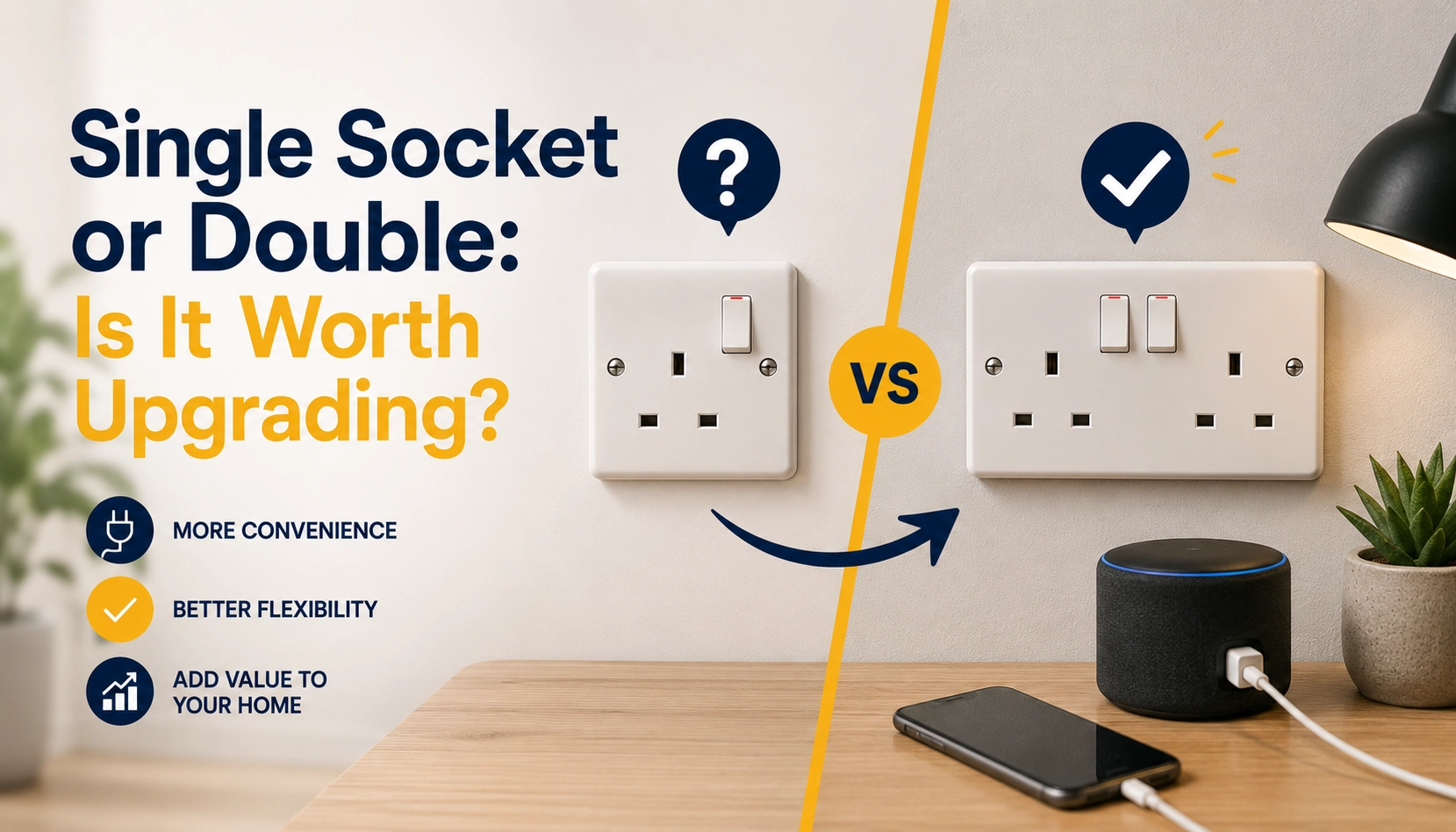
A single-to-double socket upgrade is often worth considering when one outlet is forcing daily use of adaptors, trailing leads, or awkward plug swapping.
It can make a room easier to live with, reduce clutter, and tidy up a common irritation. It is not automatically suitable in every location, because the existing wiring, circuit, back box, wall type, and earthing all need checking.
About this guide
Jon Spark carries out minor domestic electrical work in Keynsham and nearby areas, helping people with practical small jobs such as sockets, switches, bathroom pull-cords, light fittings, extractor fans, smoke and heat alarms, and simple fault checks.
This guide is written from that small-job perspective: the questions people ask before booking, what can usually be checked from photos, what tends to be discovered on site, and where a simple-looking job needs a qualified judgement rather than guesswork.
When one socket is doing the work of two every day, there is often a permanent adaptor or extension lead that has become part of the furniture. That is usually a stronger reason to upgrade than the socket simply looking dated.
What is the benefit of upgrading?
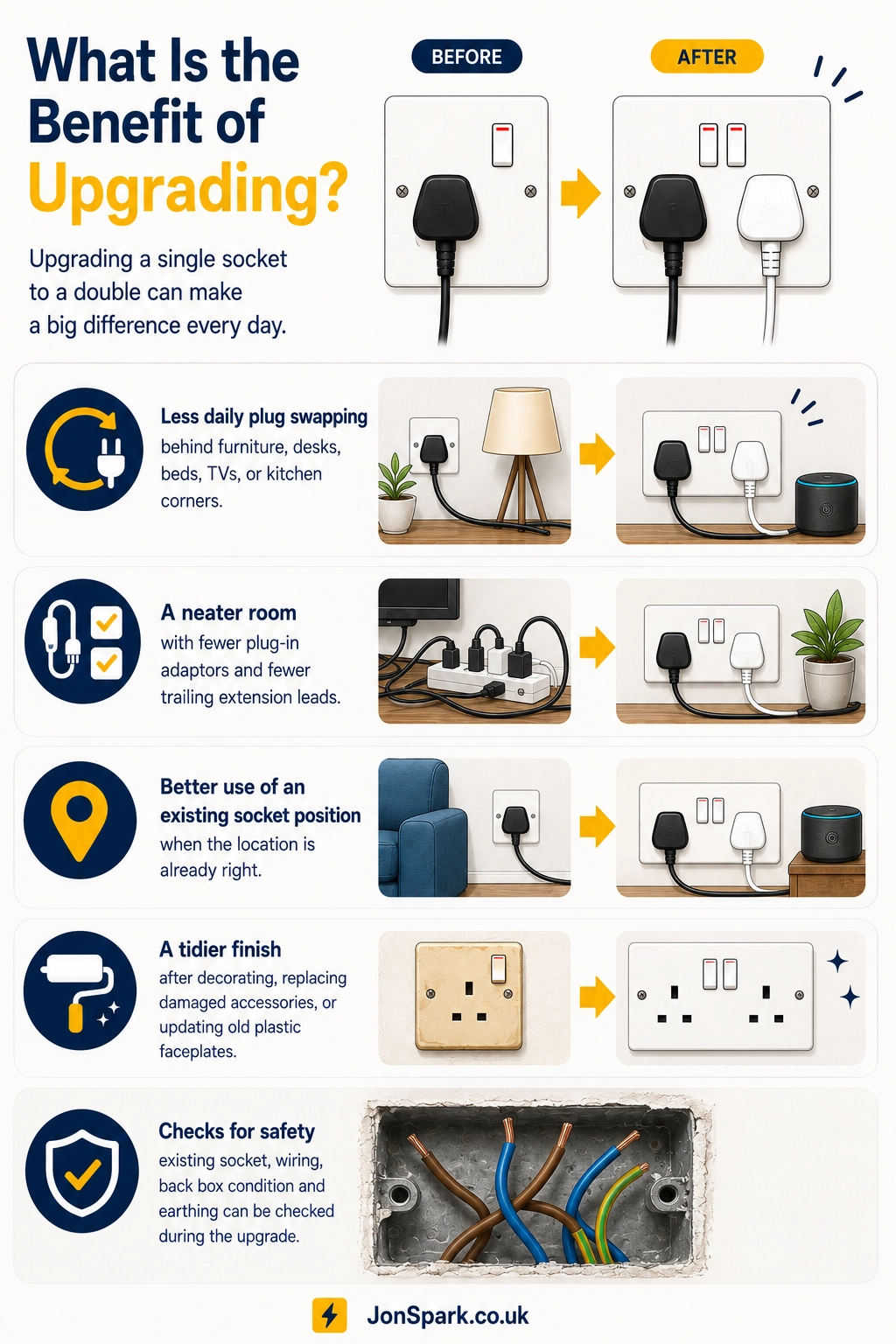
- Less daily plug swapping behind furniture, desks, beds, TVs, or kitchen corners.
- A neater room with fewer plug-in adaptors and fewer trailing extension leads.
- Better use of an existing socket position when the location is already right.
- A tidier finish after decorating, replacing damaged accessories, or updating old plastic faceplates.
- A chance to have the existing socket, back box, terminations, and earthing checked at the same time.
What is the cost of leaving it?
Doing nothing is sometimes fine, especially if the socket is rarely used. The problem is when the workaround becomes permanent. Adaptors and extension leads can be knocked, overloaded, damaged, or hidden under furniture where heat and wear are harder to spot. Even when there is no immediate danger, a messy workaround often becomes a long-term nuisance.
There is also an opportunity cost. If the existing socket is already cracked, loose, warm, buzzing, or unreliable, postponing the visit may mean living with a fault rather than dealing with it while the job is still small.
When does it make sense?
| Situation | Why it may be worth it |
|---|---|
| Home office or study corner | Two outlets can remove the need for a permanent adaptor behind a desk. |
| TV or broadband area | A neater socket position can reduce messy plug stacks and visible extension leads. |
| Bedroom socket behind furniture | A double socket can avoid constant plug swapping in an awkward place. |
| Decorating or replacing a damaged socket | If the area is already being worked on, it may be sensible to ask about upgrading at the same time. |
When is it not the right answer?
A double socket in one place is not the same as adding new socket positions around a room. If the room is generally short of outlets, or the socket is in the wrong location, a simple single-to-double conversion may only hide the real problem.
It also may not be suitable if the box is shallow, the wall is damaged, the cable length is poor, the earthing is not right, or the circuit needs further investigation.
Photos and first checks often show the details that decide whether the job stays simple: plasterboard dry-lining boxes, older brick walls, shallow metal back boxes, short conductors, or decorative faceplates.
What should you expect on the day?
- The existing socket is inspected before anyone assumes a conversion is suitable.
- The wall, back box, cable condition, and earthing are checked.
- If the existing position is suitable, the new accessory is fitted and checked.
- If it is not suitable, you should get a clear explanation rather than a forced bodge.
Cost guide
As a helpful local guide, Jon Spark's published pricing has listed single-to-double socket conversions around £75 to £110 labour at the time of publishing, with parts separate if supplied.
Prices can change, so check the current pricing page or estimator before relying on any figure.
FAQ
Is a double socket safer than an adaptor?
A properly fitted suitable double socket is often neater and more robust than relying on a permanent adaptor, but suitability has to be checked.
Does it give me more electrical capacity?
No. It gives two outlets at that position; it does not increase what the underlying circuit can safely supply.
Can every single socket be upgraded?
No. The wall, back box, wiring, circuit, and earthing all matter.
Is it worth doing just one?
Sometimes yes, especially if one awkward socket is causing daily inconvenience. It may be better value if grouped with other small jobs.
Sources and useful links
- Jon Spark - minor domestic electrical work and pricing
- GOV.UK - Approved Document P: Electrical safety in dwellings
- Electrical Safety First - DIY and electrics
About Jon Spark
Jon Spark is the trading name of Jonathan Jensen, a sole trader providing minor domestic electrical work across Keynsham and nearby areas. The service focuses on practical small jobs such as socket and switch replacements, faceplates, light fittings, pull-cords, smoke and heat alarm replacements, extractor fan swaps and minor fault finding.
These Insights articles are written to help people understand common small electrical jobs before they book, including what information is useful to send and when a job may need a different route.
This article is for general information only. It is not electrical advice, DIY instruction, legal advice, insurance advice, or a substitute for inspection by a suitably competent person.
Need help with a single-to-double socket upgrade?
Send a couple of photos, your postcode and a short description of what you want to change. I can usually tell whether it fits my small-job service and what the sensible next step is.