Can I Convert My Light Switch Into a Dimmer Switch?
A practical guide to changing a normal light switch to a dimmer, including LED compatibility, neutral wires, older homes, back boxes, costs, benefits, and when it is not straightforward.
Yes, many ordinary light switches can be changed to a dimmer, but it depends on the light fitting, the lamps or bulbs, the existing wiring, the wall box depth, the switch type, and whether the lighting is already suitable for dimming.
The biggest modern issue is not usually the switch shape; it is whether the LED lamps and the dimmer are compatible.
About this guide
Jon Spark carries out minor domestic electrical work in Keynsham and nearby areas, helping people with practical small jobs such as sockets, switches, bathroom pull-cords, light fittings, extractor fans, smoke and heat alarms, and simple fault checks.
This guide is written from that small-job perspective: the questions people ask before booking, what can usually be checked from photos, what tends to be discovered on site, and where a simple-looking job needs a qualified judgement rather than guesswork.
A dimmer upgrade is most successful when the bulbs are genuinely dimmable, the dimmer is designed for LED lighting, and the existing back box has enough space. The frustrating jobs are the ones where a cheap old dimmer is left trying to control modern low-wattage LEDs.
Why would you want a dimmer?
- Comfort: softer evening lighting in living rooms, bedrooms, dining areas, and nurseries.
- Flexibility: one room can feel brighter for cleaning or working and calmer for relaxing.
- Less glare: useful where downlights, pendants, or decorative fittings feel too harsh.
- Better finish after decorating: a tired switch can be replaced with a dimmer that suits the room.
- Potentially less wasted light: dimming can reduce unnecessary brightness, although savings depend on the lamps and use pattern.
What is the cost of getting it wrong?
The wrong dimmer can make lights flicker, buzz, shimmer, fail to dim smoothly, refuse to turn off properly, or drop out at low brightness. That is annoying for anyone using the room, and it can turn a simple upgrade into repeat visits and wasted parts.
There is also a safety and suitability point. A switch position can hide short conductors, loose terminals, no circuit protective conductor at an older switch, a shallow metal box, or a back box that is already struggling. The front plate is the visible part; the judgement happens behind it.
What options are on the market?
| Option | Best suited to | Watch out for |
|---|---|---|
| Standard LED rotary dimmer | Simple local dimming of compatible dimmable LEDs. | Needs the correct load range and LED compatibility. |
| Trailing-edge LED dimmer | Most modern dimmable LED lamps and many low-wattage lighting circuits. | Not every LED behaves perfectly; brand compatibility still matters. |
| Programmable LED dimmer | Fine-tuning low and high brightness levels to reduce flicker or drop-out. | May need setup and testing on the actual lamps. |
| Multi-gang dimmer plate | Rooms with two or more lighting zones. | Back box depth, heat, de-rating, and load per gang matter. |
| Smart dimmer | People who want app, voice, schedules, or scenes as well as wall control. | Neutral wires, hub requirements, Wi-Fi/Zigbee setup, and lamp compatibility become important. |
Do I need a neutral wire for a dimmer?
For a normal non-smart dimmer, a neutral at the switch is often not required. Many traditional UK light switches only have permanent live and switched live at the wall switch, with the neutral elsewhere, commonly at the ceiling rose, light fitting, or junction point. That is normal in many properties.
For smart dimmers and some electronic controls, neutral becomes more important because the device may need a permanent supply to power itself. Some products are designed to work without a neutral, but they can have limitations such as minimum load requirements, bypass modules, or narrower compatibility with certain LED lamps.
When looking at switch wiring, I do not treat a blue or black conductor as neutral just because of its colour. In older and mixed-age wiring, colours can be misleading, so the wiring has to be tested and identified properly.
Does the age of the property matter?
Age matters because lighting wiring methods have changed over time, and properties are often altered in stages. In some older homes, switch drops may not include a neutral. Some older lighting circuits may not have a circuit protective conductor at switch positions, which affects choices such as metal faceplates.
In more recent wiring, neutrals are more likely to be present at some switch positions, but it is still not something to guess from the age of the house alone.
Wall construction also matters. A dimmer module can be deeper than a normal switch. Plasterboard dry-lining boxes, shallow metal boxes in brick, tiled splashbacks, and decorative screwless plates can all affect how neatly the dimmer fits.
What should you check before asking for a dimmer?
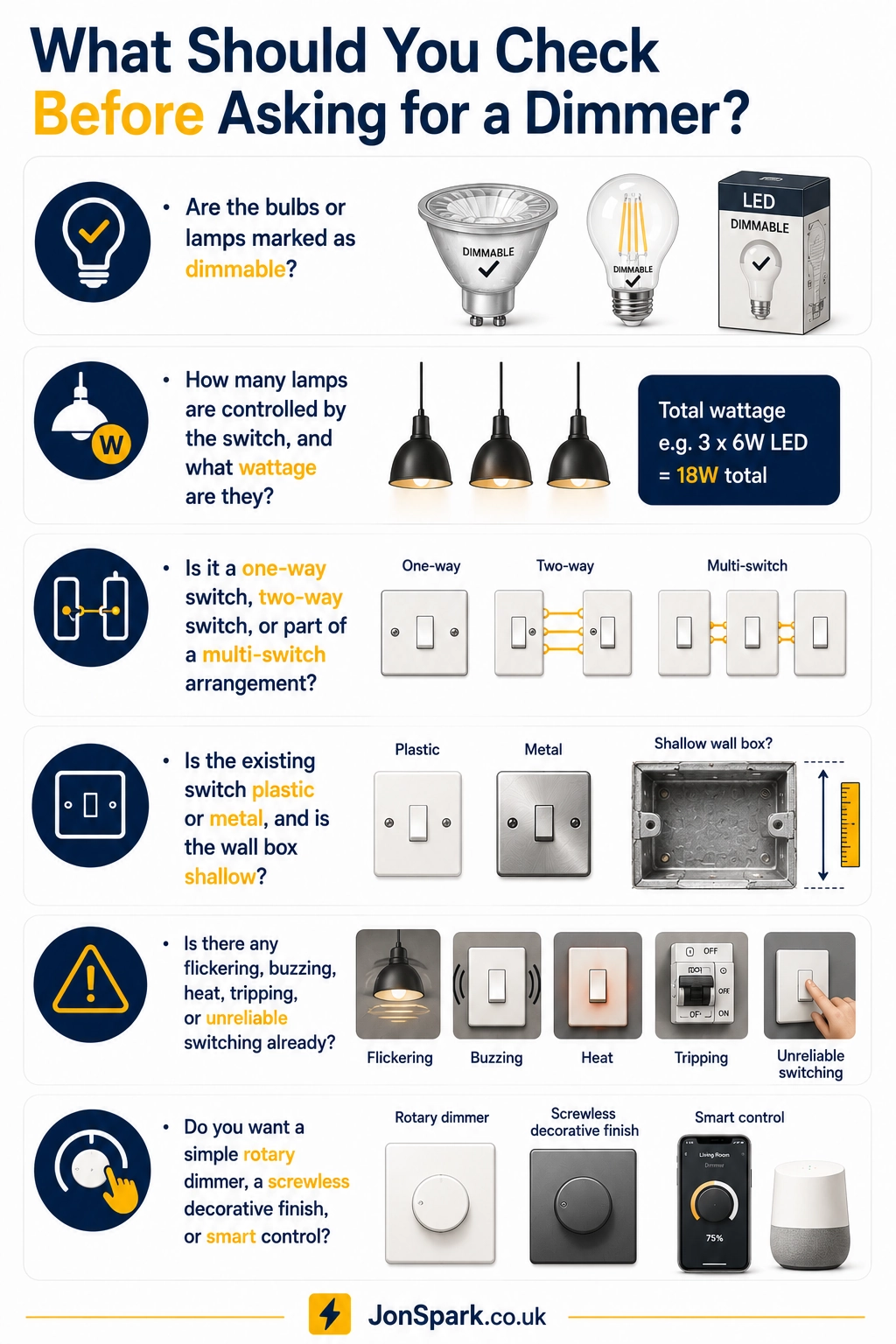
- Are the bulbs or lamps marked as dimmable?
- How many lamps are controlled by the switch, and what wattage are they?
- Is it a one-way switch, two-way switch, or part of a multi-switch arrangement?
- Is the existing switch plastic or metal, and is the wall box shallow?
- Is there any flickering, buzzing, heat, tripping, or unreliable switching already?
- Do you want a simple rotary dimmer, a screwless decorative finish, or smart control?
What happens on the day?
A sensible visit starts by checking the existing switch arrangement and confirming what the dimmer will control. If the existing lamps are unsuitable, the advice may be to change the lamps as well as the switch, or not to fit a dimmer until the lighting is compatible.
If the back box is too shallow or the wiring needs attention, that may change the job from a straightforward swap.
The most useful dimmer enquiries include a photo of the existing switch, the light fitting, and the lamps or bulbs if accessible. For downlights, I also need to know roughly how many are controlled by the switch.
FAQ
Can any light switch become a dimmer?
No. The wiring, switch arrangement, light fitting, and lamps all need to be suitable.
Why do LED lights flicker on dimmers?
Often because the LED lamps and dimmer are not compatible, the load is too low, or the dimmer needs a different mode or minimum-brightness setting.
Do I need dimmable bulbs?
Yes, for most ordinary dimmer switch setups the lamps need to be suitable for dimming.
Can I fit a metal dimmer faceplate?
Only where the earthing arrangements and installation are suitable. Older lighting circuits need particular care.
Is a dimmer worth it for one room?
Often yes if the room is used in different ways, such as bright task lighting in the day and softer lighting in the evening.
Sources and useful links
- Jon Spark - minor domestic electrical work
- VARILIGHT - V-Pro LED dimmers and LED dimming features
- Screwfix - trailing-edge dimmer switch category and LED dimmer options
- GOV.UK - Approved Document P: Electrical safety in dwellings
- Electrical Safety First - DIY and electrics
About Jon Spark
Jon Spark is the trading name of Jonathan Jensen, a sole trader providing minor domestic electrical work across Keynsham and nearby areas. The service focuses on practical small jobs such as socket and switch replacements, faceplates, light fittings, pull-cords, smoke and heat alarm replacements, extractor fan swaps and minor fault finding.
These Insights articles are written to help people understand common small electrical jobs before they book, including what information is useful to send and when a job may need a different route.
This article is for general information only. It is not electrical advice, DIY instruction, legal advice, insurance advice, or a substitute for inspection by a suitably competent person.
Need help with a dimmer switch?
Send a couple of photos, your postcode and a short description of the light fitting and bulbs. I can usually tell whether it fits my small-job service and what the sensible next step is.